


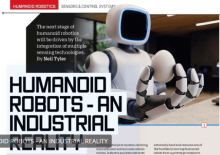
For much of the past decade humanoid robots existed largely as research projects, attracting attention through carefully controlled demonstrations rather than practical deployment. Advances in sensing technology, mechatronics, artificial intelligence and computing power, however, are enabling a new generation of robots capable of performing useful work in industrial environments and they are now being viewed as potential new industrial platforms rather than a niche research field.
At the heart of this transition is a combination of technologies that allow robots to perceive, interpret and interact with the physical world - modern humanoids typically integrate multiple sensing systems, including RGB cameras, depth sensors, inertial measurement units (IMUs), force-torque sensors and tactile sensing technologies. Advances in mechatronics have significantly improved robotic performance with components such as actuators, servo motors, harmonic reducers, planetary roller screws 1. Replicating the human hand remains a challenge and is a key hurdle holding back the commercial deployment of humanoid robots and integrated joint systems deliving more efficient and accurate robotic moves.
Industry analysts estimate that motion-control systems account for between 40% and 55% of the hardware cost of a humanoid robot, making them among the most critical elements in the supply chain. These developments have produced robots with levels of mobility and fluidity that would have been difficult to achieve only a few years ago. Improvements in motor control, lightweight materials, battery technology and real-time software have transformed robotic movement from a technological demonstration into a capability that can support productive work.
Despite notable progress in locomotion, many experts believe the industry's greatest engineering challenge now lies elsewhere: dexterous manipulation. According to Ron Zukerman, Innovation Director at Vishay Precision Group, creating a robotic hand capable of matching the adaptability and reliability of a human hand remains one of the biggest barriers to commercial deployment.